

Astronomy and Astrophysics Menu
- Collaboration between Oskar Klein Centre and Dublin Institute for Advanced Studies, April 06, 2011
- Professor Luke Drury, Director of the School of Cosmic Physics,
elected President of the Royal Irish Academy, March 16, 2011 - e-INIS federated access pilot moves to Production
- DIAS Shares the Rossi Prize, Tuesday June 30th 2009
- Carolyn Porco “ Saturn: Tripping The Light Fantastic ”, Dunsink Observatory, Tuesday June 30th 2009
- Launch of Two new Europa Stamps to Mark the UNESCO International Year of Astronomy (May 2009)
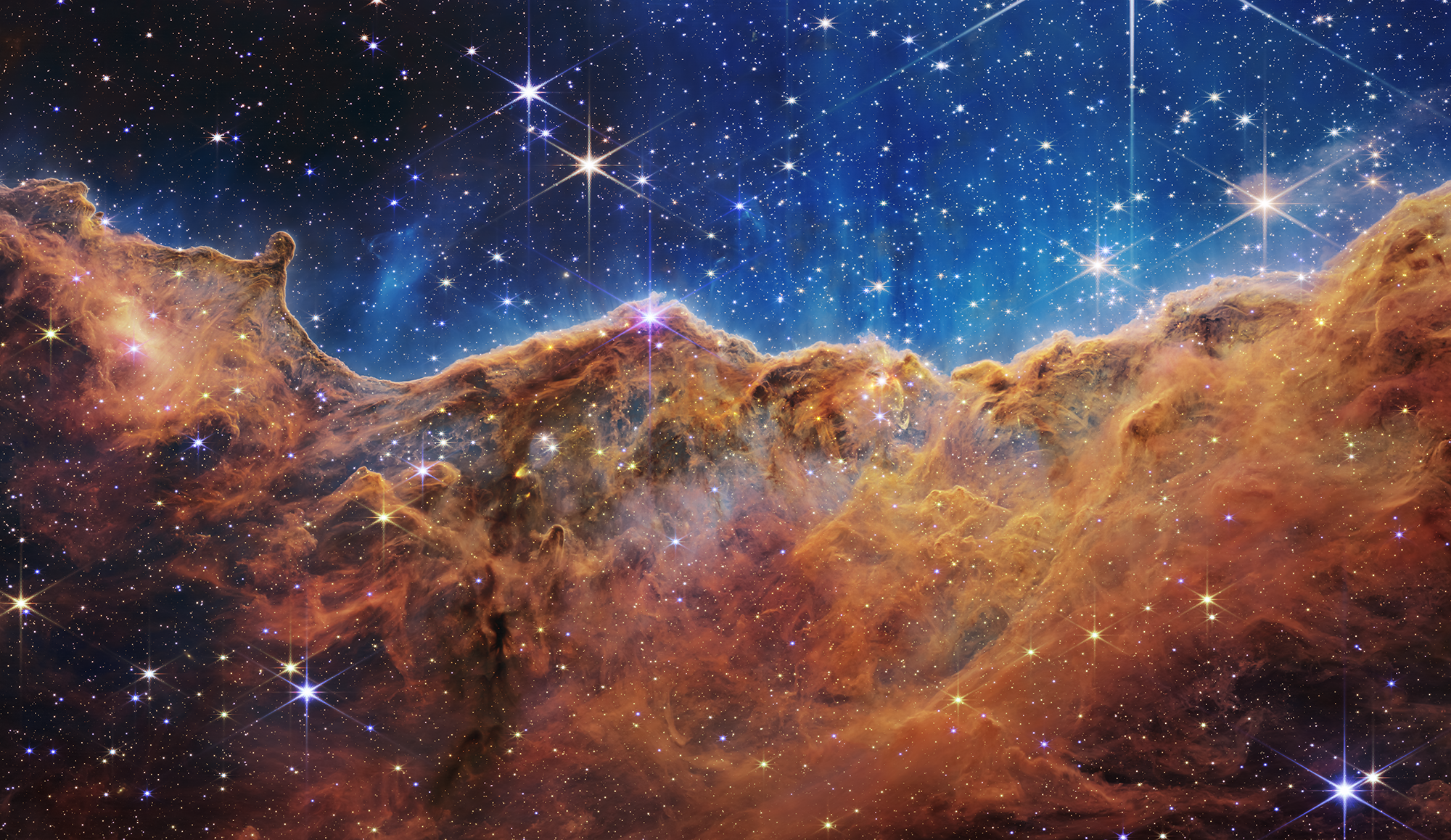
- Pillars of Creation Formed in the Shadows (April 2009)
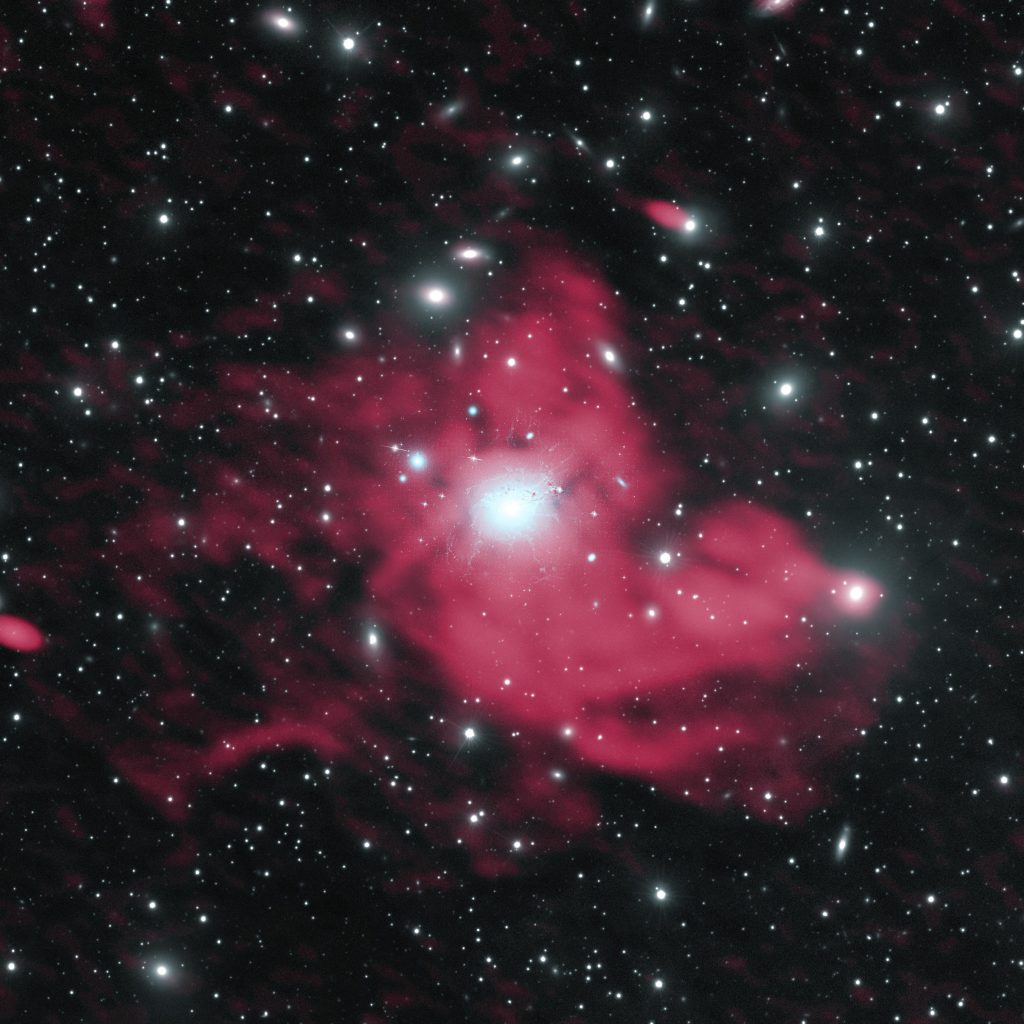
- H.E.S.S. discovers radio galaxy shining in gamma light
- Don't Forget the Leap Second
- National Capability System Makes The TOP500 List
- New Honorary Professor of Computational Science
- Highest Honour For DIAS Academic
- DIAS makes the cover of Astronomy and Astrophysics
Collaboration between Oskar Klein Centre and Dublin Institute for Advanced Studies, April 06, 2011
An international collaboration between researchers at the Oskar Klein Centre (OKC) and the Dublin Institute for Advanced Studies (DIAS) was formed last week at Dunsink Observatory, where the first joint OKC-DIAS workshop is to take place in September-October this year. For more information see the Oskar Klein Centre blog
Professor Luke Drury, Director of the School of Cosmic Physics,
elected President of the Royal Irish Academy, March 16, 2011
![]() |
We are pleased to announce that Professor Luke Drury, Director of the School of Cosmic Physics, was elected President of the Royal Irish Academy on 16th March 2011. Prof Drury is the 54th President of the Academy since it was established in 1785. He will be president for the next three years, succeeding Professor Nicholas Canny of NUI Galway. Prof Drury is a member of the Council of the Institute and Director of the School of Cosmic Physics. He is Senior Professor and Head of the Astronomy and Astrophysics Section within the School. |
e-INIS federated access pilot moves to Production
Press Release, November 12th, 2010Students To Have Online Access to Lecture Notes, Books, Resources in Every Higher Education Campus
In a major technological development announced today, Ireland moves closer to a higher education system where courses can be delivered across campuses, students can access a vast array of educational and related material in a single, simple transaction and researchers can more easily collaborate in their work across several institutions.
HEAnet, Ireland’s National Research & Education Network, today launch Edugate, a new service that allows educational institutions in Ireland to share and access online resources, including lectures, electronic books and journals and student records.
Until the arrival of Edugate, institutions needed to create user accounts for every online service for which their staff and students required access. As a result, today’s campus user has a lengthening list of user accounts covering a growing myriad of online services (e.g. email, journals, calendar, content portal, etc). It was also a cumbersome process to gain access to information and materials in other higher education institutions. HEAnet has now reduced this list to just one user access mechanism: Edugate.
Now, where a student or member of staff logs on to Edugate, he or she will have access to everything they need in their own institution but also to relevant resources in other higher education institutions.
So, a student in the University of Limerick can access an electronic journal stored in NUIG or a staff member in Cork Institute of Technology can check the academic performance of a student who previously studied in Tralee.
The new system is at the cutting edge of work in this area in Europe and will result in major efficiencies across the higher education system.
Edugate also hits the right data privacy buttons and HEAnet’s approach to protecting user privacy within Edugate has generated positive feedback from the Data Protection Commissioner’s office.
“Edugate bridges the gap between proving your identity online and retaining control of your personal data by ensuring that only the minimum amount of personal data is shared with appropriate safeguards in place”.
According to Gary Davis, Deputy Irish Data Protection Commissioner,
With today’s launch of Edugate, HEAnet, with the support of the higher education institutions, has taken another step in the delivery of cost-effective shared services to the Irish education and research community.
John Boland, CEO of HEAnet stated that, “Edugate represents another excellent example of HEAnet collaborating effectively with the universities, institutes and colleges and responding to their collective need for cost-effective shared services”.
Edugate is funded by the Higher Education Authority’s Programme for Research in Third Level Institutions through the e-INIS National e-Infrastructure programme.
For more information please visit: www.edugate.ie
For further details, please contact:
Ronan Byrne or Glenn Wearen at HEAnet
Tel: 087 673 8561 or 01 - 660 9040
www.heanet.ie
About HEAnet:
HEAnet is Ireland’s National Education and Research Network, and is a world-class provider of high quality Internet services to Ireland’s Universities, Institutes of Technology and the research and educational community, including all Irish primary and post-primary schools. It provides a high-speed national network with direct connectivity for its community to other networks in Ireland, Europe, the USA and the rest of the world.
Established in 1984 by the seven Universities with the support of the Higher Education Authority to promote the interchange of information electronically within third level education, HEAnet now plays a critical role in establishing Ireland as a global centre of excellence in Internet activity. These advanced Internet services are essential for HEAnet’s client community to develop the skills needed in the global information society.
About e-INIS:
e-INIS, the Irish National e-Infrastructure, provides Ireland’s research community with access to world-class computational, networking and support infrastructure. Coordinated by the Dublin Institute for Advanced Studies together with a number of key infrastructure and institutional partners, the project provides researchers from a wide range of disciplines with the best of ICT resources including leading-edge HPC, communications and data storage services. The project is funded by the Higher Education Authority under the Programme for Research on Third Level Institutions.
DIAS Shares the Rossi Prize
Professor Felix Aharonian has won a prestigious award from the American Astronomical Society. The 2010 Rossi prize was awarded to Felix Aharonian, Werner Hoffmann, Heinz Voelk and the H.E.S.S. (High Energy Stereoscopic System) collaboration for their outstanding contributions to imaging TeV Astronomy, which addressed fundamental questions related to particle acceleration and the origin of the Cosmic Rays through the study of SNRs, PWN and nearby AGNs. Professor Aharonian, originally from Armenia, has worked in Moscow, Yerevan, Chicago, Paris and Heidelberg before joining the Dublin Institute for Advanced Studies in 2006. His work addresses fundamental issues to do with how some astronomical systems accelerate charged particles to very high energies and the possibilities of observationally detecting these particles through the high-energy gamma rays they produce. The H.E.S.S. collaboration, of which the Dublin Institute is a member, has revolutionised the field by opening up a new observational window for astronomers at extremely high energies. See press release for more details.
Launch of two new Europa Stamps to mark the UNESCO International Year of Astronomy

As 2009 is the UNESCO International Year of Astronomy, on May 15th 2009 An Post launched two stamps that spotlight areas of astronomy, that hold special interest for Ireland.
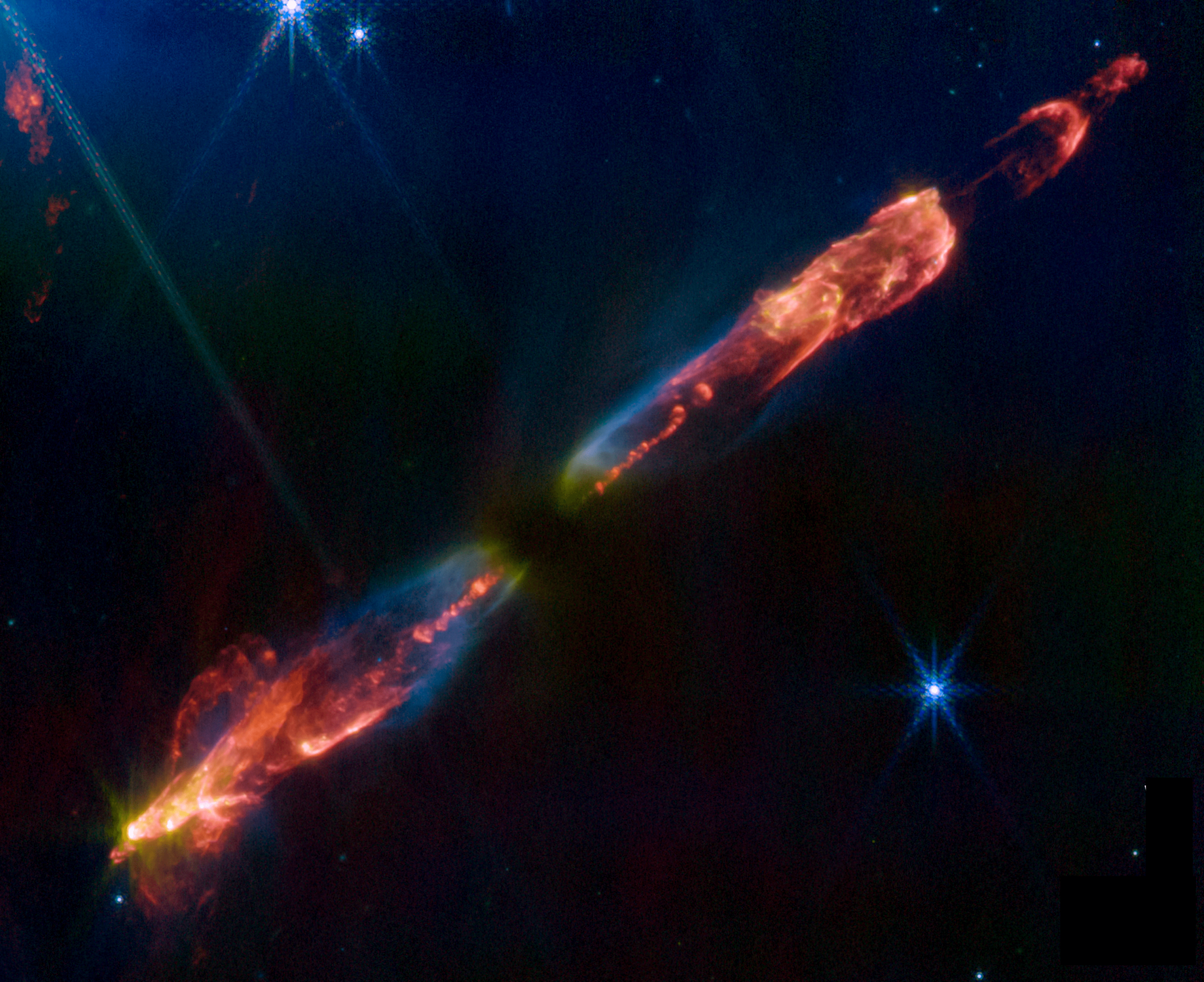
One of these stamps which shows an artist’s impression of jets from a Brown Dwarf holds special interest for DIAS. Using the European Southern Observatory’s Very Large Telescope, Dr. E.T. Whelan and Prof. T.P. Ray, two astronomers based at the Dublin Institute of Advanced Studies, recently discovered that Brown Dwarfs launch “outflows” as part of their formation process, as shown in the image.
Check here for more information on this discovery.
For information on purchase of these stamps check www.irishstamps.ie
Press Release

Don’t Forget the Leap Second: 10 … 9 … 8 … 7 … 6 … 5 … 4 … 3 … 2 … 1 … 1 … Happy New Year!
An extra leap second has to be inserted at the end of 2008, so this is how you should count down on New Year’s Eve to celebrate the start of the International Year of Astronomy according to Irish astronomers. The extra second is needed to bring the uniform measure of time used by physicists using atomic clocks back into nearly exact agreement with time as measured by the rotation of the Earth.
In effect, we stop civil time for a length of time exactly the same as that needed for the Earth to turn on its axis far enough to make sundials (if they were that accurate) agree with the atomic clocks to within one second. The decision whether to insert an occasional leap second, which happens roughly every few years, is made by the International Earth Rotation and Reference Systems Service, based in the Observatory of Paris, France.
The need to insert leap seconds into our calendar arises primarily because of the slowing down of the Earth’s rotation due to the tides raised by the Moon on the Earth as both objects orbit the Sun. The length of the mean solar day is now about 2 milliseconds longer than it was in 1820, when it was almost exactly 24 hours or 86,400 seconds long. Now, it is approximately 86,400.002 seconds. In addition, the world’s clocks are so accurate that we can detect that the Earth does not spin at an exactly constant rate. The movements of the Earth’s atmosphere, oceans and crust lead to further small changes in the rate of rotation, just as a spinning ice skater slows down if she puts her arms out or speeds up if she pulls them in again.
The leap second at the end of 2008 introduces the International Year of Astronomy 2009, which marks the 400th anniversary of Galileo’s first use of the telescope to observe the heavens. There will be national and international events organized throughout the year to mark the occasion.
Issued jointly by the Island of Ireland’s public observatories: Dunsink Observatory, Dublin; Armagh Observatory, Armagh; Imbusch Observatory, Galway; and Blackrock Castle Observatory, Cork.
The all-Ireland point of contact is Professor Mike Redfern, NUI Galway. For additional information on time and its definition in Ireland contact Dr David Malone, Hamilton Institute, NUI Maynooth, E-mail: This e-mail address is being protected from spambots. You need JavaScript enabled to view it .
Saturn: Trippping The Light Fantastic
Planetary scientist Dr. Carolyn Porco studies and interprets the photos from the Cassini-Huygens mission, orbiting Saturn and its largest moon, Titan. She and a team of scientists from NASA and the European Space Agency have been analyzing the images that Cassini has been sending back since it left Earth in 1999. Having found many new rings and four new moons, they have produced breathtaking images and animations of the stormy face of Saturn, its busy rings, and its jumble of moons and moonlets.
|
|
Her ongoing work at the Cassini Imaging Central Laboratory for Operations (CICLOPs) has two goals: to process and interpret the Cassini images for other scientists, and to make sure the images connect with the general public. She is an advocate for the exploration and understanding of planetary space, and her frequent talks (as well as her "Captain's Log" memos on the CICLOPS website) speak to everyone, scientist and nonscientist alike. Carolyn will share the wealth of images from Saturn, the Jewel of the Solar System, at Dunsink Observatory on Tuesday June 30th. If you wish to attend this event, please contact Hilary O'Donnell, |
Dr. Carolyn Porco is appearing in Ireland in association with Armagh Planetarium, Cork’s Blackrock Castle Observatory and the Dublin Institute of Advanced Studies as part of the International Year of Astronomy 2009 and the tour will highlight the IYA2009 cornerstone: She is an Astronomer .
National Capability System Makes The TOP500 List
Schrödinger, the National Capability Computing Blue Gene/P system owned by DIAS and operated by ICHEC on behalf of the entire third level research sector, is number 305 on the world TOP500 list of supercomputers as of June 2008.
New Honorary Professor of Computational Science
The Governing Board of the School of Cosmic Physics, at its last meeting, agreed to offer the position of Honorary Professor of Computational Science to the Associate Director of ICHEC, Dr J-C Desplat. Professor Desplat has accepted the offer and we look forward to collaborating with him and a further strengthening of the ties between DIAS and ICHEC.
Highest Honour For DIAS Academic
On the 16th May 2008 Professor Denis O'Sullivan of the Dublin Institute of Advanced Studies (DIAS) was admitted as a Member of the Royal Irish Academy. Election to the Royal Irish Academy is the highest academic honour in Ireland.
Professor Nicholas Canny, President of the Royal Irish Academy, said "It is a testament to Ireland's formidable position in the academic world that the Royal Irish Academy is today able to honour such a variety of exceptional scholars in the Sciences and Humanities. Ireland can be proud of these brilliant women and men who are universally recognised as leaders in the world of learning."
Professor Denis O'Sullivan is Professor Emeritus in the School of Cosmic Physics. Since 1969, Professor O'Sullivan had sixteen experiments completed on US, Russian, and European spacecraft including three Apollo missions to the moon on which some of the first investigations of galactic cosmic radiation outside the Earth's magnetosphere were undertaken. This work was followed by experiments in the orbits of Earth and Mars, in cometary environments including Halley's Comet, on several Space Shuttles and the International Space Station where he is currently studying the impact of cosmic radiation on human beings and bacteria.
The criterion for election to membership is a significant contribution to scholarly or scientific research as shown in the candidate's published academic work. Membership of the Academy, which is by peer nomination and election, is limited to those scientists and scholars normally resident in Ireland.About the Royal Irish Academy (RIA)
The Royal Irish Academy is an all-Ireland, independent, academic body that promotes study and excellence in the sciences, humanities and social sciences. It is the principal learned society in Ireland.
For 223 years membership of the Royal Irish Academy has been keenly competed for, as it is the highest academic honour in Ireland and a public recognition of academic achievement. There are now 404 Members of the Academy, in disciplines from the sciences, humanities and social sciences. Those elected are entitled to use the designation 'MRIA' after their name.
Among the membership of the Academy are many of Ireland's leading scholars, the best known of whom include: Professor Seamus Heaney, Nobel Laureate; Dr Garret FitzGerald, economist and former Taoiseach; Professor Fergus Kelly, Director of the School of Celtic Studies, DIAS; and Professor Werner Nahm, School of Theoretical Physics, DIAS.
The Academy has also more than 50 distinguished honorary Members, who in the past have included J.W. Von Goethe, Maria Edgeworth, Albert Einstein and Max Born. Today the Honorary Members include Nobel Laureates, Murray Gell-Mann, Steven Weinberg and Sir Andrew Huxley.
Further information can be found on www.ria.ie
DIAS makes the cover of Astronomy and Astrophysics

Dr Carlos del Burgo and Dr Gareth Murphy have made the cover of Astronomy & Astrophysics and been the subject of highlight articles on 1 January and 1 February respectively.
Cover illustration: Eastern shells in NGC 5982 (HST data) and Spitzer emission (C. del Burgo, et al., p. 116) Astronomy and Astrophysics, Vol. 477 No. 1 (January I 2008). |
Cover illustration: Interacting magnetised jets from a young binary (G. C. Murphy, et al., p. 457) Astronomy and Astrophysics Vol. 478 No. 2 (February I 2008). |